Balatro
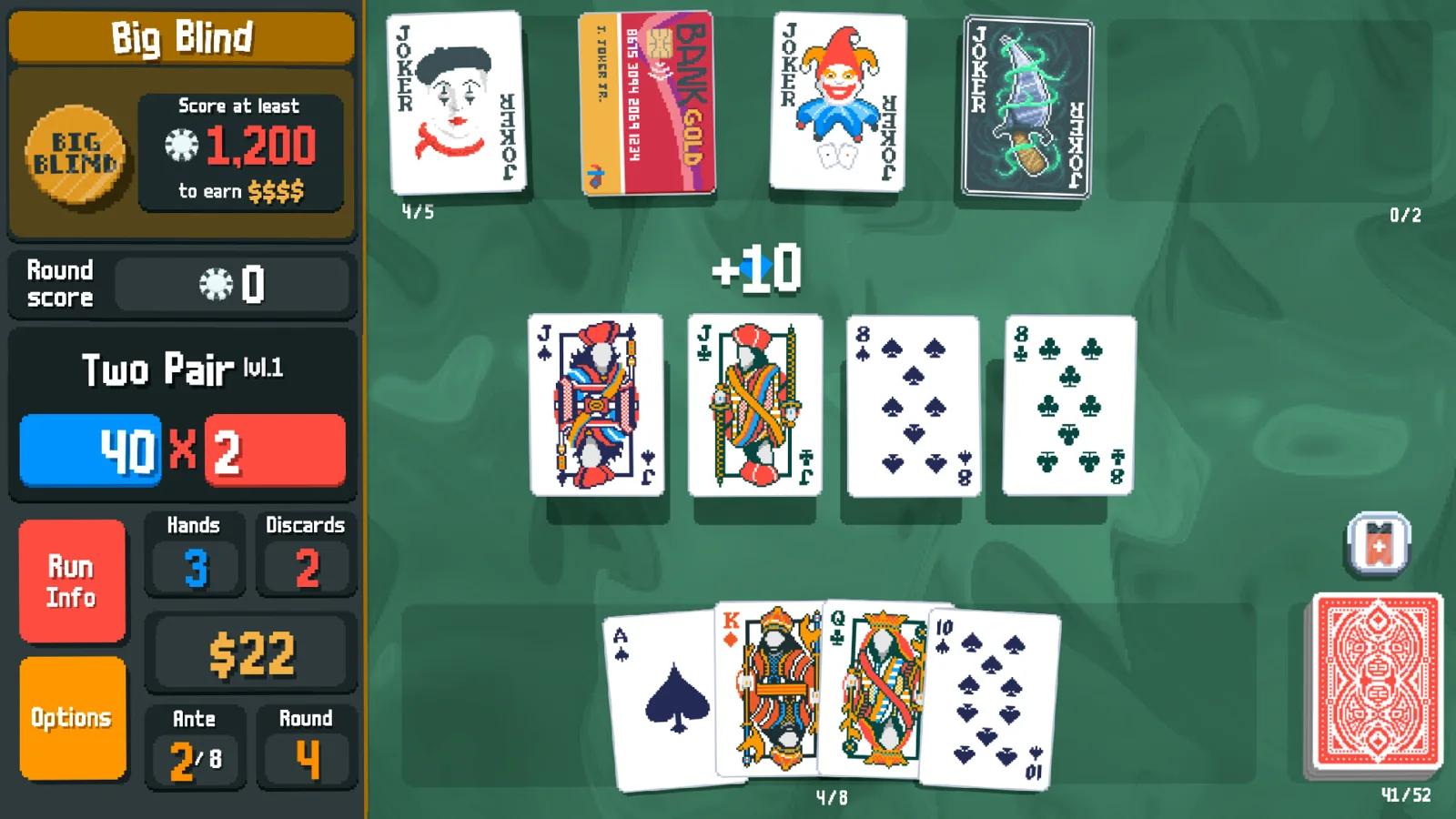
Balatro uses poker-hand patterns as inputs to a single-player scoring engine. Jokers change what those patterns are worth, turning the player’s task from finding a good hand into constructing a coherent scoring strategy.
Standard run structure; deck- and stake-specific exceptions excluded.
The appeal
Discover an improbable combination, understand it, and make the numbers soar.
- draw
- discard
- play
- score
- buy
- sell
- combine
Gameplay loops
Moment-to-moment loop
Inspect a hand and modifiers, discard or play, resolve the score, and judge the remaining target.
Session loop
Beat blinds, use shop opportunities to improve the build, and adapt to Boss Blind restrictions through the run.
Across sessions
Unlock additional possibilities and learn interactions across repeated runs. A new run requires building a new engine rather than inheriting the previous score.
Mechanics
- Structured score checks
- The official FAQ describes three rounds per Ante (Small, Big, and Boss Blind), with a special Boss Blind at Ante 8 in a traditional run. [1]
- Jokers change incentives
- The FAQ describes Jokers that add multipliers, alter number-card behavior, or earn cash, and asks players to choose limited slots carefully. [1]
A decision
A new Joker improves a hand you rarely play, while your existing slots support a reliable lower-value pattern.
The best isolated bonus may be weaker than a smaller bonus that triggers reliably alongside the rest of the build.
What makes it interesting
Recognizable hand patterns reduce part of the initial vocabulary, while modifiers create a different game from competitive poker.
Escalating score targets demand growth; Boss restrictions test whether a build is adaptable or depends on one fragile assumption.
Where it can fall short
- Layered multipliers can make cause and effect difficult to track. Feedback should reveal which interaction produced the score.
- Random offers support adaptation but can also produce disappointment. Memorable high scores are not evidence that every run gives equal opportunities.
When does a modifier change strategy rather than just inflate output?
Use ordinary playing cards and a simple target score. Offer one flat bonus and one bonus for repeatedly playing the same hand pattern.
Observe whether players change discards, purchases, or hand selection; ask them to explain the scoring chain before resolving it.
Notes save in this browser.
Related lessons
- Rules, mechanics, and systems →See how a few interacting rules can produce many situations.
- Choices, uncertainty, and risk →Give players alternatives they can reason about without removing every surprise.
- Feedback and game feel →Make actions legible, responsive, and satisfying to perform.
- Progression and motivation →Distinguish getting better, getting stronger, and discovering something new.
Sources
Mechanics are cited below. The analysis and exercises are our interpretation. About the sources
Checked October 19, 2026.
- Playstack/LocalThunk: Balatro FAQ ↗Primary rules for Antes, blinds, Jokers, and unlocks.
- Balatro official site ↗Primary description of the deckbuilder and Joker combination premise.