Clash of Clans
Clash of Clans links a persistent village to attacks and shared war goals. It illustrates how short tactical activity, longer construction goals, and social coordination can operate on different timescales.
Home Village and standard Clan Wars; Builder Base, Clan Capital, and seasonal balance excluded.
The appeal
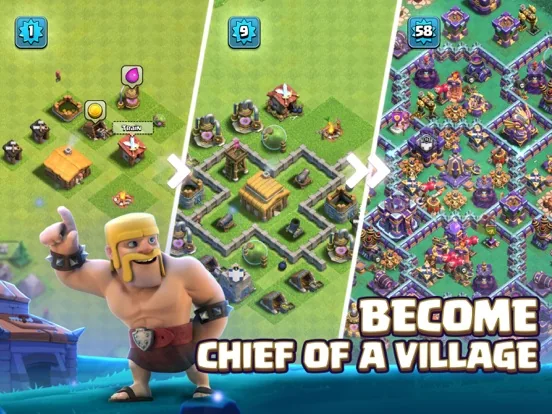
Grow a village that feels yours and contribute a useful attack to a shared effort.
- build
- upgrade
- arrange
- scout
- deploy
- donate
- coordinate
Gameplay loops
Moment-to-moment loop
Inspect a base, choose an approach, deploy an army and use available abilities, then evaluate the result.
Session loop
Attack, collect and invest resources, adjust the village or army, and prepare the next objective.
Across sessions
Village and army upgrades persist across sessions. Clan Wars add preparation, limited attacks, and a shared result rather than replacing individual development.
Mechanics
- Persistent ownership
- Supercell describes customizing a village, building an army, fighting opponents, and joining or creating a clan. [1]
- Preparation and limited attempts
- Official Clan War rules describe scouting and base preparation before Battle Day. Each participant has two attacks on different enemy War Bases; stars determine the result, with destruction percentage breaking a tie. [2]
A decision
Your clan needs a reliable result, but one ambitious target might yield a larger improvement than a safer target.
Individual strength is only part of the decision. Limited attempts and shared scoring give coordination a concrete purpose.
What makes it interesting
Village building gives tactical rewards a persistent use, while attacks supply information about layouts and army choices.
Preparation and a shared scoreboard give clan members something specific to discuss: which base to attack, which army to bring, and what to learn from a replay.
Where it can fall short
- Upgrade schedules and social expectations can turn anticipation into obligation. Assess whether a session feels satisfying independently of the desire to avoid falling behind.
- Persistent power complicates fairness comparisons; a loss may reflect preparation, progression, matchup, execution, or several together.
Do shared limited attempts encourage useful coordination?
Make three paper bases with distinct weaknesses and give each of two players two different army cards. Allow two attacks each; score only the team’s best result on each base.
Compare silent and discussion rounds. Record target duplication, planning, and whether weaker players have a useful role.
Notes save in this browser.
Related lessons
- The core loop →Connect actions, feedback, and changed situations across seconds, sessions, and longer journeys.
- Choices, uncertainty, and risk →Give players alternatives they can reason about without removing every surprise.
- Progression and motivation →Distinguish getting better, getting stronger, and discovering something new.
- Multiplayer and social design →Design the relationships between people as carefully as the rules of a match.
Sources
Mechanics are cited below. The analysis and exercises are our interpretation. About the sources
Checked October 19, 2026.
- Supercell: Clash of Clans ↗Primary description of village customization, armies, and clans.
- Supercell: Intro to Clan Wars ↗Primary explanation of preparation, scouting, attacks, scoring, and rewards.