Fortnite
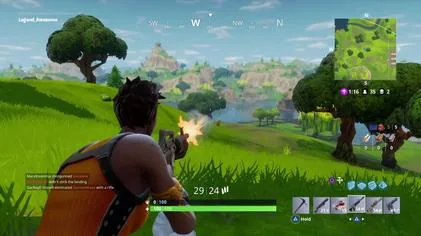
Fortnite Battle Royale combines survival, scavenging, positioning, and player-built structures. This study focuses on how a contracting safe area and construction create changing decisions within a shared last-survivor objective.
Battle Royale with building; Zero Build is a comparison, not the main ruleset. Seasonal items excluded.
The appeal
Improvise under pressure and turn an uncertain landing into a memorable survival story.
- land
- loot
- move
- aim
- build
- edit
- survive
Gameplay loops
Moment-to-moment loop
Find supplies, assess nearby threats and the safe area, choose a route or fight, and spend resources to survive.
Session loop
Drop onto the island, survive successive Storm phases, and try to become the last player or team standing.
Across sessions
Skill, map knowledge, rank, and cosmetic goals can persist; each match rebuilds its immediate inventory and survival situation.
Mechanics
- Convergence by the Storm
- Epic describes an island with 99 opponents, an encroaching Storm, and a last-player-standing victory condition. [1]
- A removable signature system
- Epic explicitly distinguishes Zero Build from the building version. The Creative storm documentation exposes configurable phases, illustrating how designers tune spatial pressure. [1]
A decision
The safe area is moving, an opponent is ahead, and your resources are limited.
Position, time, equipment, and construction resources have value together; a stronger inventory is useless if the route cannot be survived.
What makes it interesting
The Storm provides an external pacing force, changing the map’s useful space and limiting indefinite avoidance.
Construction lets players create temporary geometry. It adds expressive defenses and routes while increasing the execution and knowledge needed to compete.
Where it can fall short
- Elimination can end participation early; different formats and social expectations change how costly that feels.
- Construction expertise can widen skill gaps. Zero Build demonstrates that removing a system can serve a different audience rather than merely simplify the same experience.
How quickly should a survival arena force encounters?
Use a token grid with four players and a safe area shrinking every three turns; repeat with every six turns. Add a limited wall-building resource.
Track waiting, unavoidable losses, route choices, and whether walls create alternative plans rather than automatic safety.
Notes save in this browser.
Related lessons
- Challenge, difficulty, and fairness →Create opportunities to learn and choose how costly failure should be.
- Level and world design →Use space to guide attention, create choices, and pace discoveries.
- Genre, audience, and studying games →Use familiar conventions deliberately and compare designs without copying their scale.
- Multiplayer and social design →Design the relationships between people as carefully as the rules of a match.
Sources
Mechanics are cited below. The analysis and exercises are our interpretation. About the sources
Checked October 19, 2026.
- Epic: Battle Royale ↗Primary mode overview, Storm, victory objective, Ranked, and Zero Build comparison.
- Epic: Advanced Storm Controller ↗Primary creator documentation on tuning a battle-royale-like Storm; not a claim about exact live Battle Royale values.