Grand Theft Auto V
GTA V places authored missions and self-directed exploration in one city. Driving, traffic, pursuit, and three protagonists create room for improvisation, while mission objectives set a deliberate pace.
Single-player Story Mode: the 2013 campaign and its later ports. Excludes GTA Online’s live economy, multiplayer heists, and ongoing content.
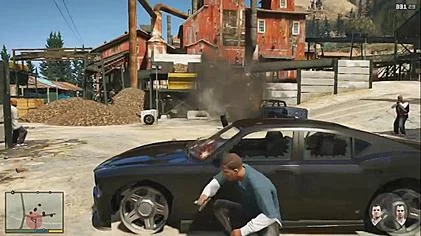
The appeal
Step into a cinematic crime story, then choose your own detours through Los Santos and Blaine County.
- drive
- explore
- aim
- take cover
- switch characters
- plan
- escape
Gameplay loops
Moment-to-moment loop
Read the street or encounter → choose a route or action → respond to traffic, opposition, or pursuit → reassess.
Session loop
Follow a mission and its objectives, or choose a free-roam activity; resolve the encounter, recover, and select the next goal.
Across sessions
Advance the campaign, gain money and equipment, improve character-specific skills, and build personal knowledge of routes and activities.
Mechanics
- One world, different levels of direction
- The official gameplay presentation juxtaposes story missions and heist preparation with optional activities and open-world exploration. [2]
- Three perspectives and distinct abilities
- Michael, Franklin, and Trevor can be switched during supported missions. Their special abilities emphasize gunfights, driving, and combat durability respectively. [1]
- Pursuit makes consequences visible
- A one-to-five-star wanted indicator communicates police interest. The world and its road network become part of a player’s response to trouble. [1]
- Recovery has a cost
- The manual describes hospital revival with a fee after defeat and separate skill growth for each protagonist. Failure need not erase campaign progress. [1]
A decision
During a free-roam chase, you approach a crowded intersection with a fast main road and a tighter side street.
Speed, vehicle handling, space, and a limited ability interact. The shortest route is not necessarily the easiest route to execute.
What makes it interesting
Authored objectives can provide a strong dramatic arc while free-roam play lets a player invent a smaller story. Study where direction and freedom pull against each other, without assuming every mission supports every sandbox solution.
Traffic and street geometry make familiar driving verbs produce changing situations. A small map with interacting obstacles can teach more about this principle than an enormous empty city.
Character switching changes what the player can see and act on. Compare a multi-character mission with a solo encounter: what opportunities does each perspective provide?
Where it can fall short
- A player may expect sandbox freedom inside a mission that requires a specific action or sequence; unclear boundaries can turn improvisation into frustration.
- Pursuit is exciting only while players can understand enough of the response to act. An escalating penalty can discourage exploration if recovery feels too costly.
- Contrast retrying a mission segment with recovering after free-roam defeat. Depending on the situation, a failure cost can encourage practice or make repetition tiring.
- Production scale is a poor first-project target. GTA Online’s social systems and monetization require a separate analysis.
Does a directed objective improve a small driving sandbox without making its choices feel fake?
Make a six-intersection paper or simple digital map with traffic obstacles, a pursuer, and two routes. Compare free escape with a delivery objective. Use your own explicit visibility and capture rules; these are not a reproduction of GTA V’s police AI.
Track route changes, unexpected obstacle interactions, and failures. Ask whether the objective helped players choose a goal or constrained an appealing solution. Compare an immediate retry with a short recovery cost.
Notes save in this browser.
Related lessons
- Rules, mechanics, and systems →See how a few interacting rules can produce many situations.
- Choices, uncertainty, and risk →Give players alternatives they can reason about without removing every surprise.
- Challenge, difficulty, and fairness →Create opportunities to learn and choose how costly failure should be.
- Level and world design →Use space to guide attention, create choices, and pace discoveries.
- Narrative, theme, and aesthetics →Connect what a player does with the meaning and mood of the experience.
Sources
Mechanics are cited below. The analysis and exercises are our interpretation. About the sources
Checked October 19, 2026.
- Grand Theft Auto V: official Xbox One game help ↗Primary manual: Character Switching, Player Stats, Special Abilities, and HUD sections. Historical platform-specific controls; use the Story Mode sections. Do not generalize promotional language or the manual’s imprecise description of maximum wanted response.
- Rockstar Games: Grand Theft Auto V official gameplay video (2013) ↗Developer presentation of the mission, heist-planning, character-switching, and open-world design. Promotional footage is selective and does not demonstrate that every mission permits unrestricted improvisation.
- Rockstar Games: Grand Theft Auto V ↗Official product overview. Distinguish Story Mode from the separately evolving GTA Online experience and platform enhancements.