Resident Evil
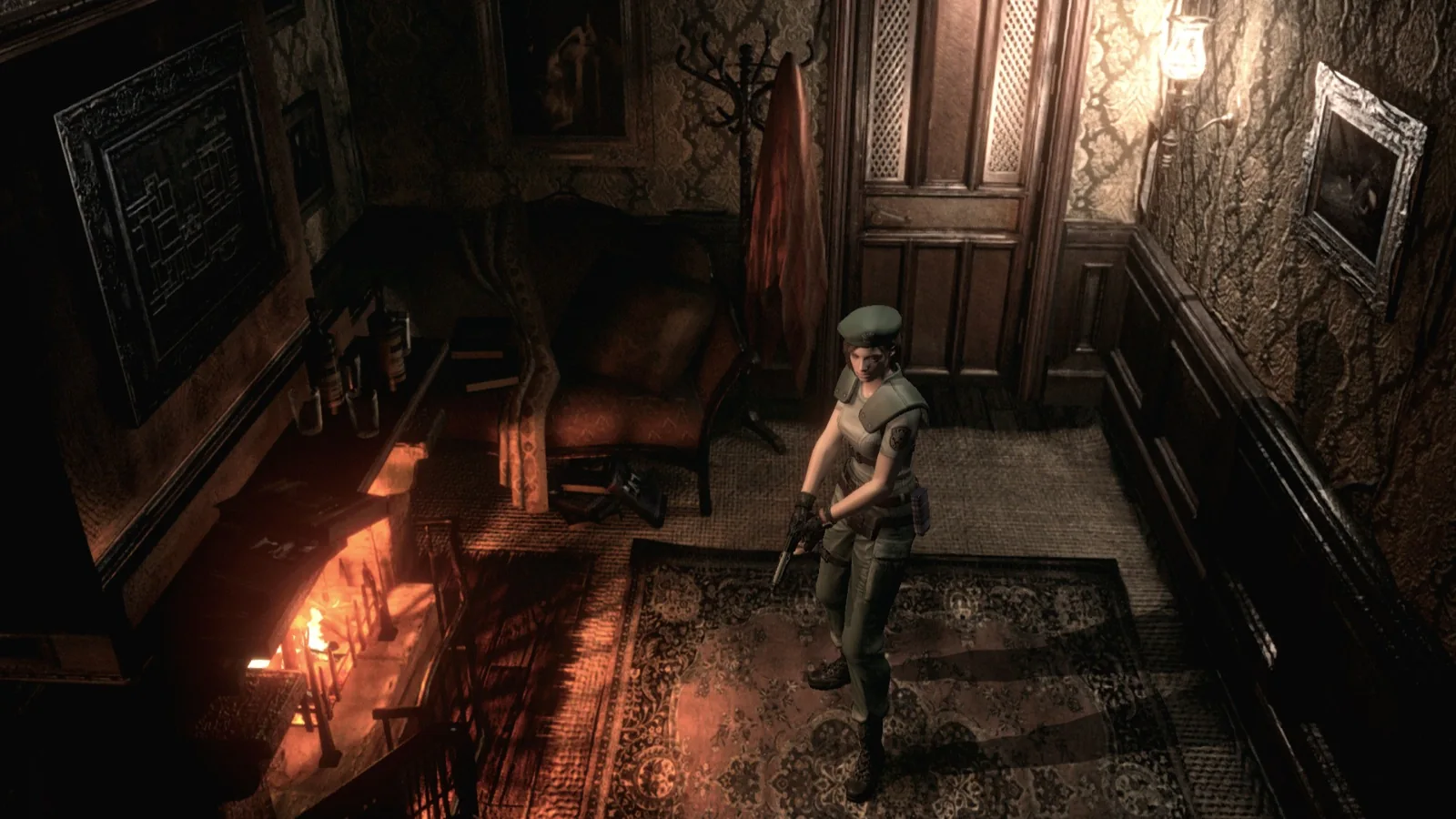
Resident Evil links exploration, combat, keys, limited carrying capacity, and restricted resources. The same mansion routes are traversed repeatedly, so choosing whether to remove a threat can affect several future journeys.
Original 1996 mansion design. The GOG source documents the original PC version; the Director’s Cut manual supplies supplementary rules. Neither source is the 2002 remake.
The appeal
Survive an unfamiliar place by becoming careful, prepared, and knowledgeable.
- explore
- inspect
- unlock
- evade
- shoot
- store
Gameplay loops
Moment-to-moment loop
Inspect a room → choose a route or resource use → confront or avoid a threat → collect information or an item.
Session loop
Make an expedition from a safe location, solve a local obstacle, and return with progress.
Across sessions
Unlock connected spaces, understand the mansion, and preserve enough resources for later threats.
Mechanics
- Bounded supplies and carrying space
- The supplementary official Director’s Cut manual documents limited carrying slots, item boxes, equipping weapons, combining items, and healing. It supports these shared mechanics, not a claim that every mode and platform has identical balance. [1]
- A dangerous mansion
- The authorized original-PC listing preserves the 1996 description of creatures across mansion rooms and surrounding spaces. The route-planning consequences discussed below are design interpretation. [2]
A decision
A zombie blocks a hallway you expect to use again, but ammunition is limited.
The value of an attack includes future access, not just the immediate encounter.
What makes it interesting
Uncertainty about future needs can create tension without a constant stream of enemies.
Spatial familiarity changes the experience over time. A frightening unknown building becomes a route network the player can reason about.
Where it can fall short
- Inventory trips can become repetitive rather than tense.
- Fixed viewpoints and the original movement conventions can hide threats or create control friction; these constraints do not feel equally fair to all audiences.
Does a recurring threat produce a meaningful resource decision?
Draw a small interconnected map. Place one persistent enemy on a frequently used route and give the player ammunition for only two removals.
Track which threats players eliminate, their predicted future routes, and whether backtracking changes the earlier decision’s value.
Notes save in this browser.
Related lessons
- Players, play, and a promise →Decide who you are making an experience for and what it should offer them.
- Choices, uncertainty, and risk →Give players alternatives they can reason about without removing every surprise.
- Level and world design →Use space to guide attention, create choices, and pace discoveries.
Sources
Mechanics are cited below. The analysis and exercises are our interpretation. About the sources
Checked October 19, 2026.
- Capcom: Resident Evil Director’s Cut manual ↗Official supplementary manual for a revision of the original; not a 1996 edition manual.
- Capcom/GOG: original Resident Evil ↗Authorized original-PC edition with its preserved 1996 marketing description. Modern compatibility changes are not treated as original design features.