Royal Match
Royal Match combines constrained puzzle boards with a persistent renovation journey. It provides a useful contrast to competitive games: the immediate problem is efficient use of moves, while visible completion offers a longer horizon.
Regular match-three levels and castle renovation; event rules excluded.
The appeal
Read a board, solve a compact challenge, and watch a cheerful world take shape.
- swap
- match
- combine
- clear
- plan
- renovate
Gameplay loops
Moment-to-moment loop
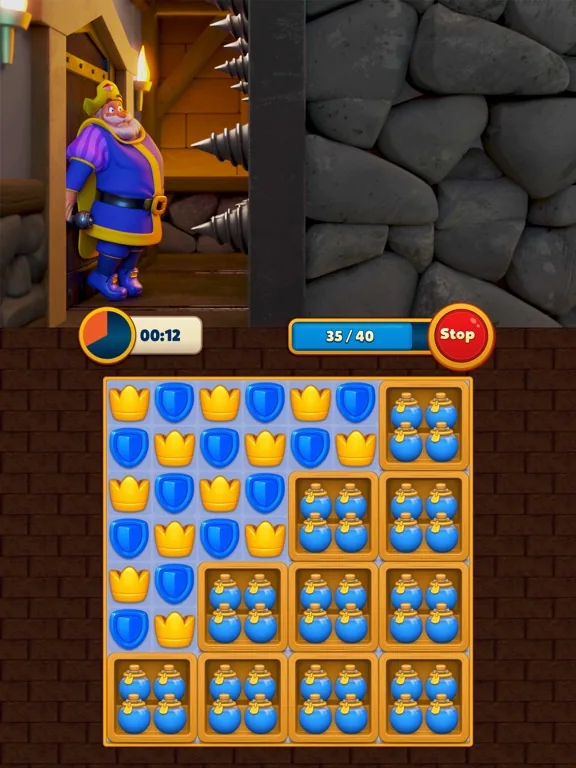
Inspect targets, make a match or trigger a power-up, watch the board change, and choose the next move.
Session loop
Complete every target within the move limit or retry the level with a revised approach.
Across sessions
Advance through levels and unlock castle areas; events add separate goals outside this case’s scope.
Mechanics
- Targets constrain matching
- The official help center explains that levels require one or more targets within limited moves, using matches and power-ups. [1]
- Combinations and a destination
- Dream Games describes combinations such as Rocket with TNT, blockers, and unlockable castle areas. The renovation theme gives the puzzle sequence a visible destination. [2]
A decision
A small match clears a needed target now; another move could create a power-up beside a blocker.
The target and the remaining moves decide which move is useful; the one with the largest animation may not be it.
What makes it interesting
A limited move budget makes efficiency visible without requiring real-time reflexes.
Cascades and combinations can make one swap set off an elaborate result. Completing areas gives separate boards a sense of continuity.
Where it can fall short
- Newly revealed tiles make future outcomes uncertain; a player needs enough visibility to judge a plan without requiring perfect prediction.
- Retries, resource offers, and monetization can create pressure around failure. Evaluate satisfaction separately from retention or spending.
Does a level target encourage planning beyond making any available match?
Create a small paper match-three board with fixed refill cards. Compare “clear ten tiles” with “clear three marked blockers” under the same move budget.
Count moves directed toward the objective and ask players which outcomes felt earned, surprising, or arbitrary.
Notes save in this browser.
Related lessons
- The core loop →Connect actions, feedback, and changed situations across seconds, sessions, and longer journeys.
- Choices, uncertainty, and risk →Give players alternatives they can reason about without removing every surprise.
- Feedback and game feel →Make actions legible, responsive, and satisfying to perform.
- Progression and motivation →Distinguish getting better, getting stronger, and discovering something new.
Sources
Mechanics are cited below. The analysis and exercises are our interpretation. About the sources
Checked October 19, 2026.
- Dream Games: How do I play Royal Match? ↗Primary target, matching, and move-limit rules.
- Dream Games: Royal Match ↗Primary description of power-up combinations, areas, visual world, and events.