Slay the Spire
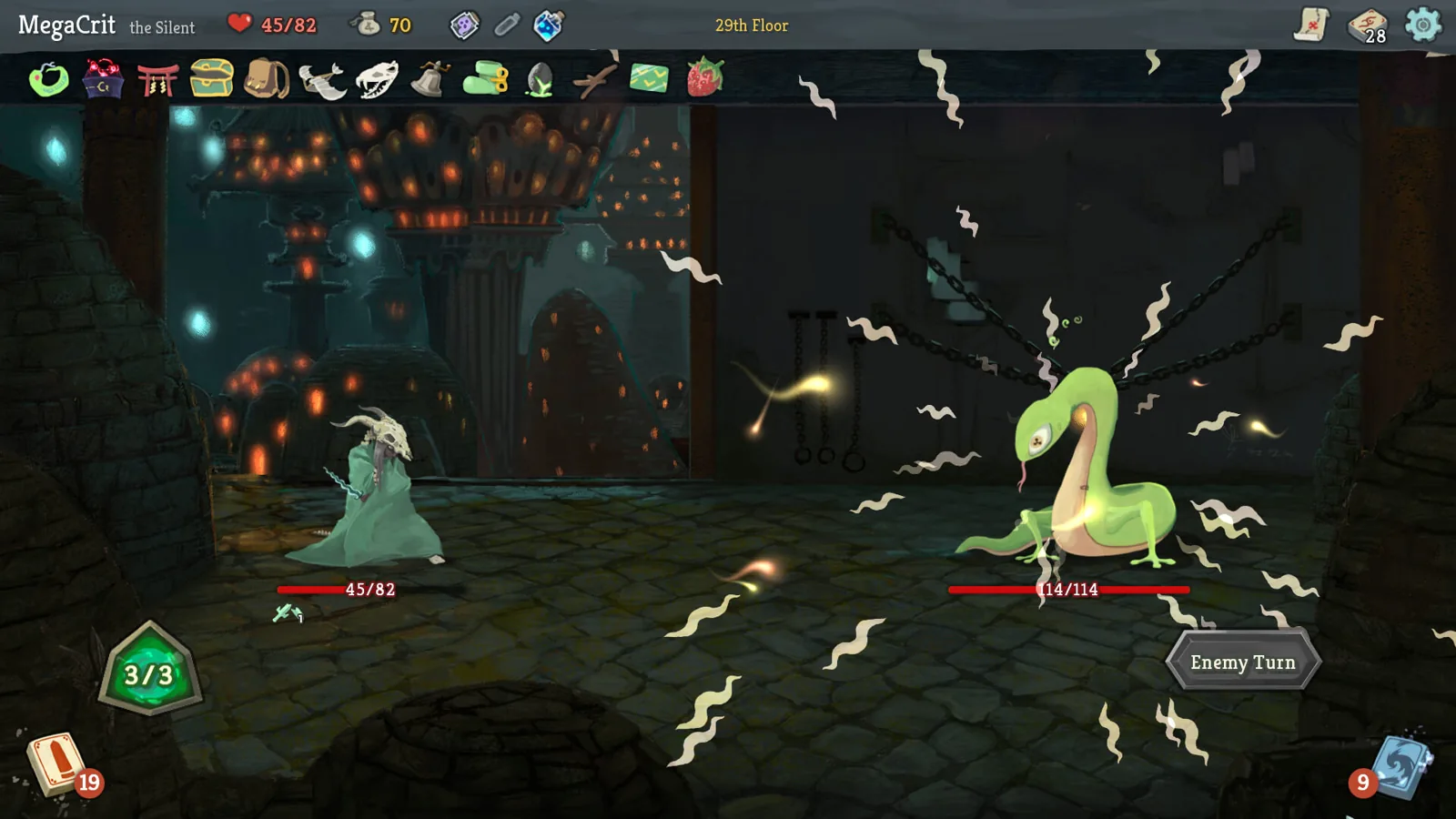
Slay the Spire joins card-by-card combat with decisions about what the deck should become. A card can be powerful in isolation and still be wrong for the current route, resources, and existing interactions.
The original single-player game; not Slay the Spire 2 or the board game.
The appeal
Adapt a fragile plan into an unusual engine and discover how far it can climb.
- play
- block
- attack
- draft
- skip
- route
- upgrade
Gameplay loops
Moment-to-moment loop
Read enemy intent, spend energy on cards, resolve the turn, and manage health through the fight.
Session loop
Choose a route through fights, events, shops, and rest sites while changing the deck and collecting relics.
Across sessions
Runs reset the build; knowledge, unlocks, and harder challenges support longer-term development. Different characters offer distinct card sets.
Mechanics
- Deck construction during the journey
- Mega Crit’s store description emphasizes choosing cards that work together and choosing safer or riskier routes through a changing Spire. [1]
- Relics change relationships
- Relic effects can enhance a deck through interactions, while obtaining them can have costs beyond gold. [1]
- Balance is tested
- The developers’ metrics-and-balance talk documents measurement as part of iteration; it does not establish a universal mathematical definition of fun. [2]
A decision
A reward offers a strong expensive attack, but your deck already struggles to defend and draw its best cards.
A reward is not automatically an improvement: adding an option also changes what future draws contain.
What makes it interesting
Immediate survival and future deck quality pull against one another, giving health and route choices strategic meaning.
Visible enemy intent lets players reason about limited resources, while varying offers prevents a run from being fully planned in advance.
Where it can fall short
- The number of card and relic interactions can overwhelm newcomers; clear intent and small early decisions carry substantial teaching work.
- A long failed run can feel wasted unless the player recognizes an experiment, discovery, or decision to improve next time.
Can declining a reward become an interesting decision?
Make a ten-card combat deck and three rewards. Add every reward in one trial; permit skipping in another. Use a fixed enemy sequence.
Track unwanted draws and ask whether players can explain what their deck needs instead of choosing the largest printed number.
Notes save in this browser.
Related lessons
- Rules, mechanics, and systems →See how a few interacting rules can produce many situations.
- Choices, uncertainty, and risk →Give players alternatives they can reason about without removing every surprise.
- Progression and motivation →Distinguish getting better, getting stronger, and discovering something new.
- Prototyping and playtesting →Turn a design promise into a question you can investigate.
Sources
Mechanics are cited below. The analysis and exercises are our interpretation. About the sources
Checked October 19, 2026.
- Mega Crit: Slay the Spire on Steam ↗Developer-authored overview of dynamic deckbuilding, paths, relics, and characters.
- Anthony Giovannetti: Metrics Driven Design and Balance ↗Primary developer presentation on testing and balancing the original game.
- Mega Crit: Slay the Spire press kit ↗Primary version and feature reference.