Undertale
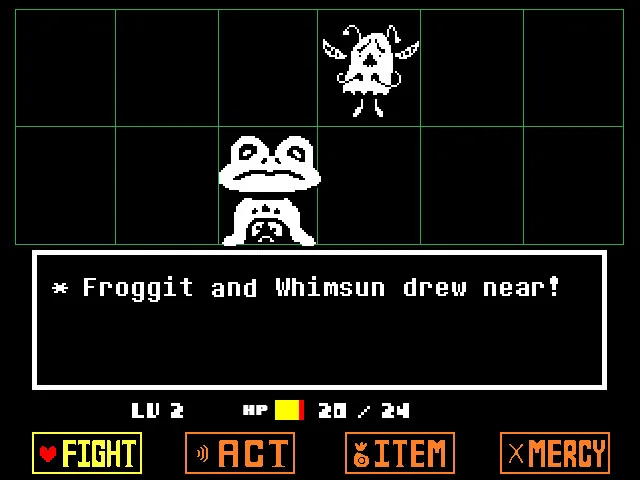
Undertale combines role-playing encounters with active dodging and nonviolent interaction. Its choices invite attention to individual opponents rather than treating every encounter as the same damage calculation.
Original 2015 game; major story revelations deliberately omitted.
The appeal
Find your own relationship with a strange world and its inhabitants.
- talk
- act
- fight
- spare
- dodge
- explore
Gameplay loops
Moment-to-moment loop
Encounter an opponent → choose an action → observe their response → dodge their attack pattern → revise your approach.
Session loop
Explore an area, meet characters, and resolve encounters through the chosen approach.
Across sessions
Develop knowledge of characters and see narrative consequences; growth need not mean maximizing combat statistics.
Mechanics
- Nonviolent resolution
- Toby Fox’s official description states that enemies can be overcome without killing and highlights character dialogue and player choice. [1]
- Active defense
- Enemy turns involve distinct patterns to dodge. The developer’s Steam description explicitly combines unconventional battle resolution with timed attacks and evasion. [2]
A decision
An opponent’s behavior suggests they want attention rather than a fight.
Reading personality can become practical information. A nonviolent option needs mechanics and feedback, not only a moral label.
What makes it interesting
Changing the meaning of a familiar RPG command can make a player reconsider habits learned from other games.
Recognizable attack behavior can express character, linking narrative interpretation with moment-to-moment movement.
Where it can fall short
- Consequences can feel opaque if players do not know what a choice means.
- Replaying to see every outcome may encourage choices that conflict with the player’s first emotional response.
Can a nonviolent resolution be as legible as attacking?
Make one paper encounter with attack, observe, and two contextual actions. Let the opponent’s responses reveal how they feel.
Ask players why they chose each action. Check whether they infer a personality or merely guess until a hidden sequence succeeds.
Notes save in this browser.
Related lessons
- Choices, uncertainty, and risk →Give players alternatives they can reason about without removing every surprise.
- Narrative, theme, and aesthetics →Connect what a player does with the meaning and mood of the experience.
- Genre, audience, and studying games →Use familiar conventions deliberately and compare designs without copying their scale.
Sources
Mechanics are cited below. The analysis and exercises are our interpretation. About the sources
Checked October 19, 2026.
- Toby Fox: About Undertale ↗Official account of nonviolent encounters, unique enemy patterns, humor, and choice.
- Undertale on Steam ↗Developer-authored description of attack timing and alternative battle resolution.