BioShock
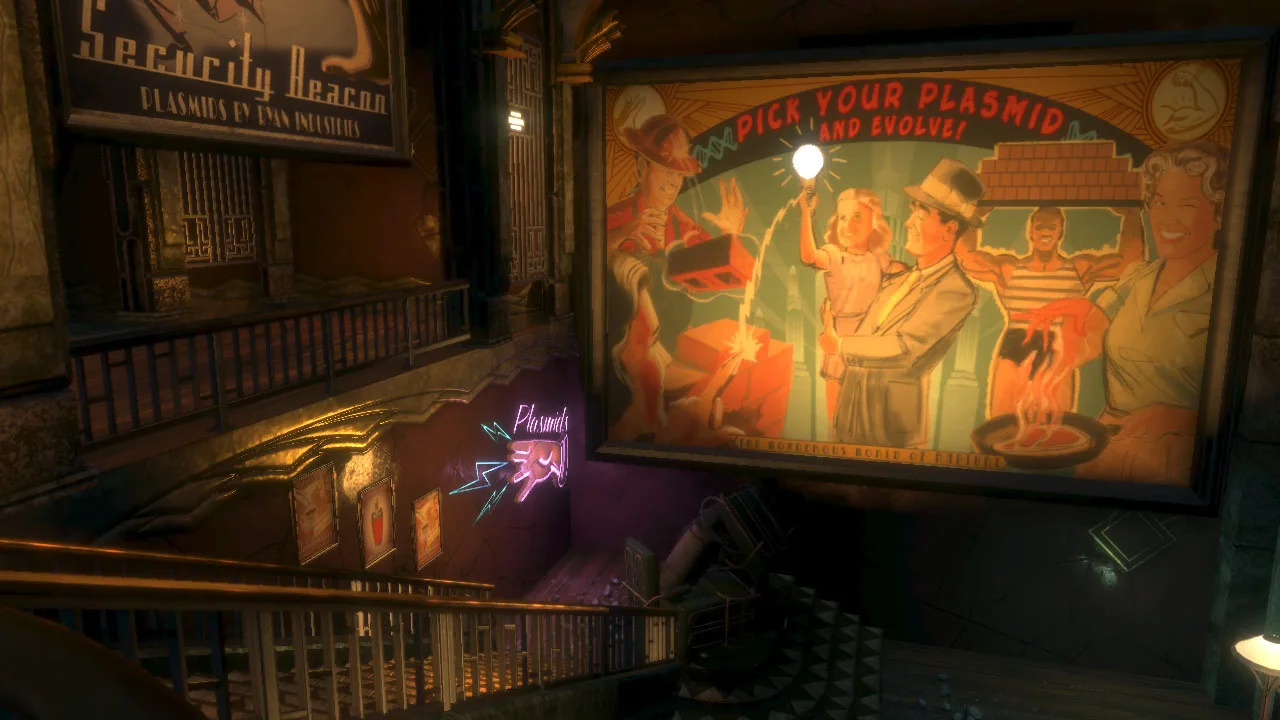
BioShock combines first-person combat with powers, resource management, environmental storytelling, and morally framed decisions. Players encounter the setting’s ideas through architecture, recordings, characters, and consequences.
Original 2007 game; the official PS3 manual documents a later port. Major plot twists omitted.
The appeal
Investigate a spectacular failed society while adapting to its dangers.
- explore
- shoot
- use plasmids
- hack
- listen
- choose
Gameplay loops
Moment-to-moment loop
Inspect threats and resources → combine a weapon or power with the environment → survive → search and learn.
Session loop
Explore a district, pursue an objective, acquire resources, and encounter fragments of the city’s history.
Across sessions
Acquire and configure abilities while uncovering the society’s collapse and making consequential choices.
Mechanics
- Interacting combat tools
- The official manual documents weapons, plasmids, EVE, and environmental interactions. A player’s available resources constrain which combination is practical. [1]
- World and moral framing
- The publisher’s product description presents the environment as a source of weapons and tactical opportunities. The manual also documents the Little Sister decision and its resource implications. [2]
A decision
An enemy stands near a useful environmental feature while your power resource is limited.
A spectacular interaction is meaningful when it competes with other viable uses of limited resources.
What makes it interesting
Recordings and physical remnants let players assemble a history while exploring, but their placement determines whether listening supports or interrupts action.
Thematic choices become more concrete when they touch the resource economy. That economy can also weaken the intended moral tension if one option becomes obviously advantageous.
Where it can fall short
- Listening during combat can divide attention and obscure important information.
- A strongly framed moral choice offers fewer expressive possibilities than an open social simulation; presentation should not imply unlimited narrative freedom.
Can an environment communicate a social conflict before a character explains it?
Stage one abandoned room with three objects, one optional recording, and two possible interpretations.
Ask what players believe happened before and after hearing the recording. Check whether evidence invites inference or merely requires exposition.
Notes save in this browser.
Related lessons
- Rules, mechanics, and systems →See how a few interacting rules can produce many situations.
- Choices, uncertainty, and risk →Give players alternatives they can reason about without removing every surprise.
- Narrative, theme, and aesthetics →Connect what a player does with the meaning and mood of the experience.
Sources
Mechanics are cited below. The analysis and exercises are our interpretation. About the sources
Checked October 19, 2026.
- 2K: BioShock official manual ↗Primary manual for the original game’s later PS3 edition; controls may differ.
- 2K: BioShock on Xbox ↗Publisher product description of tools and environmental combat possibilities.