Brawl Stars
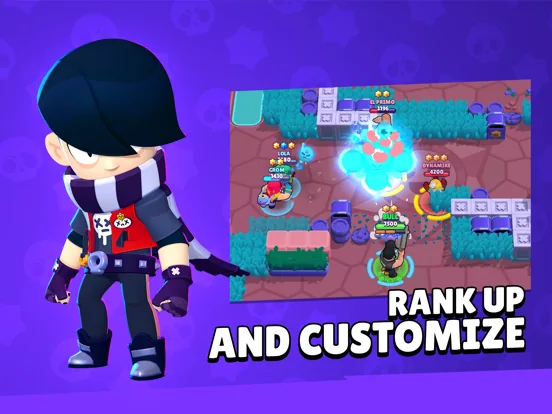
Brawl Stars combines readable character abilities, movement, and team objectives in compact matches. It shows how a shared objective changes the value of shooting, protecting space, and retreating.
Short competitive battles, with Gem Grab as the main teaching example. Modes and progression change over time.
The appeal
Make a decisive contribution to a team in a short, repeatable match.
- move
- aim
- attack
- dodge
- coordinate
- protect
- retreat
Gameplay loops
Moment-to-moment loop
Find a useful position, threaten an opponent, manage attacks, and reposition as the objective changes.
Session loop
Choose a brawler and mode, contest the objective, finish the match, and review what changed its outcome.
Across sessions
Collect and upgrade brawlers while building matchup and map knowledge. Friendly battles provide a useful practice environment without trophy rewards.
Mechanics
- Mode changes meaning
- Supercell describes quick multiplayer matches across team and battle-royale modes; winning is not a single universal kill-count rule. [1]
- Practice without collection advantage
- Friendly battles use fully upgraded brawlers, allow rules to be adjusted, and do not award trophies. [2]
A decision
In Gem Grab, your teammate holds most of the team’s gems and an enemy is retreating.
A tempting local success can undermine the team objective. Read the mode’s current rules before treating this as tactical advice.
What makes it interesting
Short travel distances make positioning mistakes produce visible consequences quickly, helping players connect action to outcome.
Distinct attack shapes and team roles can generate variety from a small map, reducing the need for a large world.
Where it can fall short
- Collection and upgrades complicate comparisons of execution skill; practice formats can isolate that variable.
- Fast action can become visually crowded. Character readability, latency, and touch-control accuracy affect perceived fairness.
Does an objective produce useful teamwork beyond chasing opponents?
Make a two-team paper or digital arena with one attack per character. Compare elimination scoring with carrying tokens to safety.
Record whether players protect carriers, split into roles, or still ignore the objective; interview both teammates.
Notes save in this browser.
Related lessons
- The core loop →Connect actions, feedback, and changed situations across seconds, sessions, and longer journeys.
- Challenge, difficulty, and fairness →Create opportunities to learn and choose how costly failure should be.
- Feedback and game feel →Make actions legible, responsive, and satisfying to perform.
- Multiplayer and social design →Design the relationships between people as carefully as the rules of a match.
Sources
Mechanics are cited below. The analysis and exercises are our interpretation. About the sources
Checked October 19, 2026.
- Supercell: Brawl Stars ↗Primary overview of short matches and multiple modes.
- Supercell: Teams and Friendly Battles ↗Primary description of practice rules and upgraded brawlers.
- Supercell: StarrToon patch notes ↗Primary historical mode discussion including classic Gem Grab and its variant; current rules can differ.