Dark Souls
Limited resources make expeditions costly, while repeated encounters let players learn routes. Unlocking a shortcut changes the risk and effort of later journeys.
Original 2011 design, with its original-game PC manual as reference; not Dark Souls II or III.
The appeal
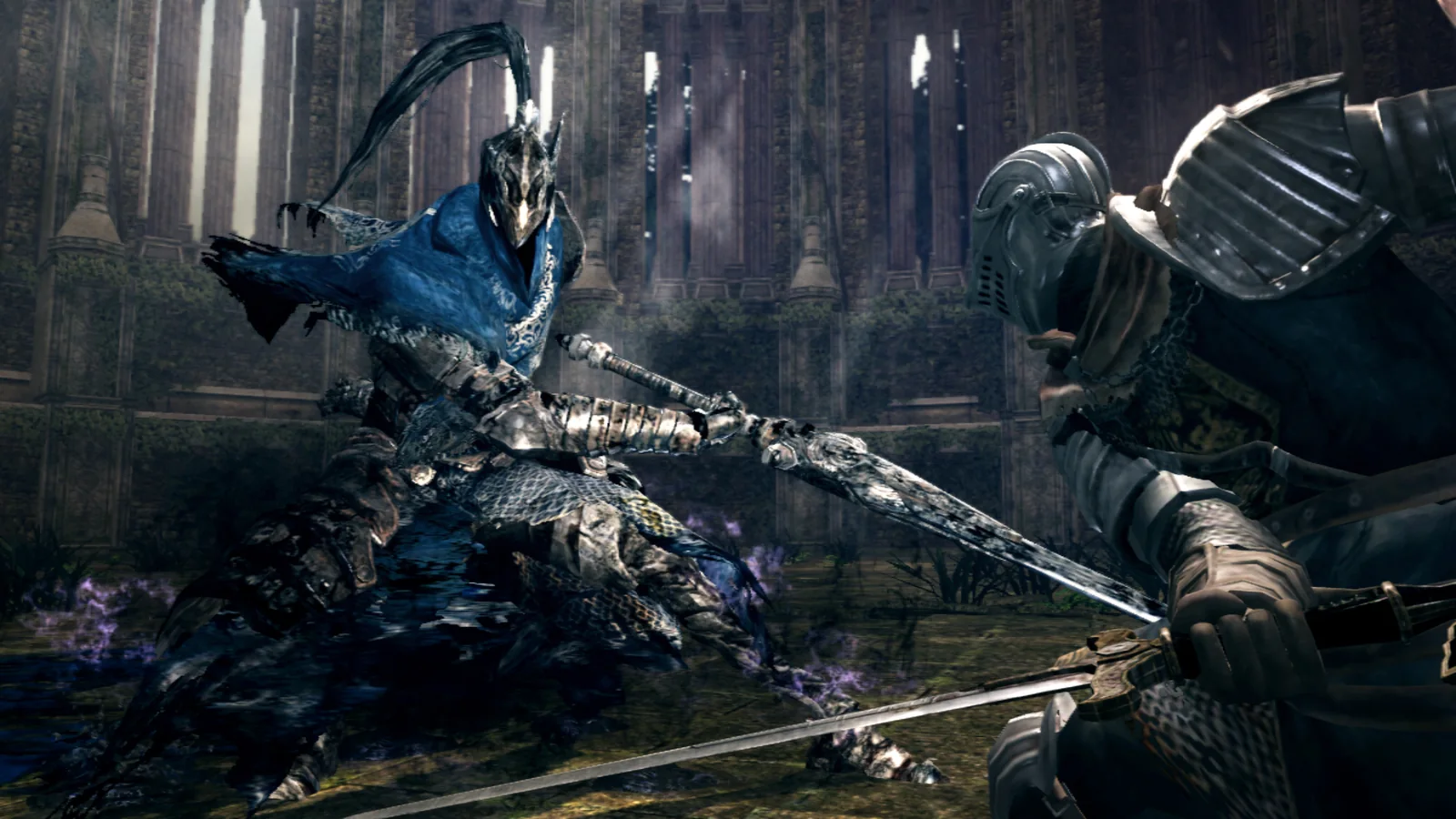
Survive a hostile place by learning its routes, enemies, and limits.
- observe
- block
- dodge
- attack
- retreat
- unlock
Gameplay loops
Moment-to-moment loop
Read a threat → choose a committed action → manage stamina and position → learn the outcome.
Session loop
Travel from safety, gather progress, seek a shortcut or boss, and decide whether to continue.
Across sessions
Convert souls into character growth and equipment while acquiring durable route knowledge.
Mechanics
- Bonfires and souls
- The original-game manual explains bonfires, the souls counter, death, combat, and character development. [1]
- Connected paths
- The original-game manual describes vertically arranged spaces, interlinking routes, and secret corridors. Its bonfires also anchor exploration by restoring resources and serving as respawn points. [1]
A decision
You have gained souls and have little healing left; an unfamiliar corridor lies ahead.
The same geography supports risk assessment because the player remembers the cost of crossing it.
What makes it interesting
Opening a shortcut can reward knowledge and change future traversal, making relief tangible without granting a large statistical bonus.
Committed actions can make enemy recognition and spacing matter. Readability, recoverability, and retry cost determine whether failure supports learning.
Where it can fall short
- Lengthy return journeys can make a useful lesson feel expensive to practise.
- Hidden information can create mystery but also make players misdiagnose a viable route as impossible.
Can a shortcut provide a satisfying reward by changing future effort?
Build a six-room paper dungeon whose final room unlocks a direct route to safety. Keep combat rewards small and consistent.
Ask players what changed after unlocking it; record whether they recognize reduced risk and travel cost.
Notes save in this browser.
Related lessons
- Challenge, difficulty, and fairness →Create opportunities to learn and choose how costly failure should be.
- Feedback and game feel →Make actions legible, responsive, and satisfying to perform.
- Level and world design →Use space to guide attention, create choices, and pace discoveries.
Sources
Mechanics are cited below. The analysis and exercises are our interpretation. About the sources
Checked October 19, 2026.
- Dark Souls original-game PC manual ↗Publisher manual for the original game’s 2012 PC edition. Printed pages 12–13 directly document stamina, bonfires, bloodstains, and interconnected routes; no Remastered changes are assumed.
- Dark Souls: FromSoftware original product page ↗Developer’s 2011 game page confirms original scope and describes tense exploration and discovery as design aims, not measured player outcomes.