Half-Life
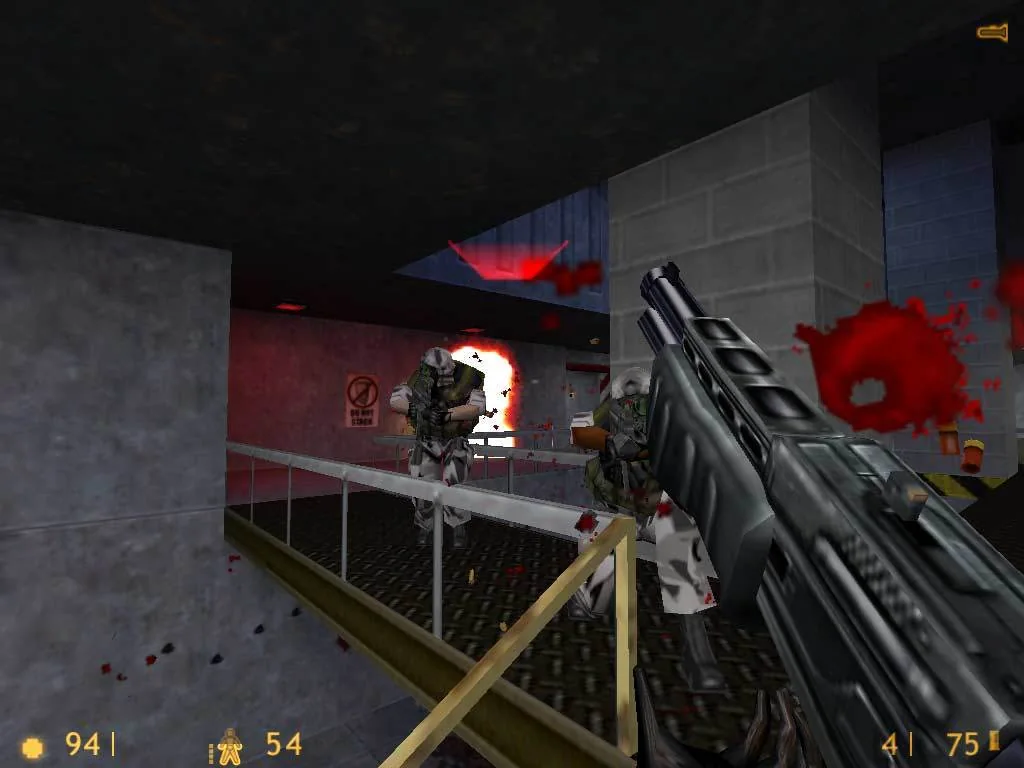
Half-Life combines first-person combat, navigation, environmental hazards, and scripted events. The opening establishes an ordinary workplace before turning familiar spaces into an unfolding disaster.
Original 1998 campaign; anniversary materials document its development.
The appeal
Survive a catastrophe that appears to happen around you.
- observe
- move
- fight
- use
- navigate
Gameplay loops
Moment-to-moment loop
Read a space → identify a threat or route → act → see the environment respond.
Session loop
Advance through connected sequences of combat, navigation, and environmental problems.
Across sessions
Gain tools and knowledge while the campaign transforms the context of the journey.
Mechanics
- Scripted events in a continuous viewpoint
- Valve’s anniversary documentary discusses technology, scripted sequences, opening levels, and narrative. Events can establish stakes while the player retains a first-person viewpoint. [1]
- Varied encounter problems
- Valve describes a combination of action, adventure, technology, and storytelling. The campaign asks for environmental reading alongside combat execution. [2]
A decision
A hazardous room contains an enemy and a possible route around it.
A continuous environment can carry both tactical information and story information; observing is itself an action.
What makes it interesting
Establishing a mundane place before disrupting it gives later destruction a reference point.
Changing the dominant task can sustain attention across a linear campaign without requiring a branching story.
Where it can fall short
- A retained viewpoint does not guarantee agency; the route and event outcome can remain heavily authored.
- Environmental ambiguity can leave players unsure whether an obstacle is an intentional puzzle or a navigation failure.
Can staging communicate an event without taking control away?
Build one corridor where a visible system fails and changes the route. Provide a safe place to observe it.
Ask players what happened and what they intend to do next. Check whether moving freely causes them to miss essential information.
Notes save in this browser.
Related lessons
- Feedback and game feel →Make actions legible, responsive, and satisfying to perform.
- Level and world design →Use space to guide attention, create choices, and pace discoveries.
- Narrative, theme, and aesthetics →Connect what a player does with the meaning and mood of the experience.
Sources
Mechanics are cited below. The analysis and exercises are our interpretation. About the sources
Checked October 19, 2026.
- Valve: 25th anniversary documentary ↗Original developers discuss scripted sequences, opening levels, weapons, and narrative.
- Valve: Half-Life on Steam ↗Developer overview of the original game’s integrated action and storytelling.