Into the Breach
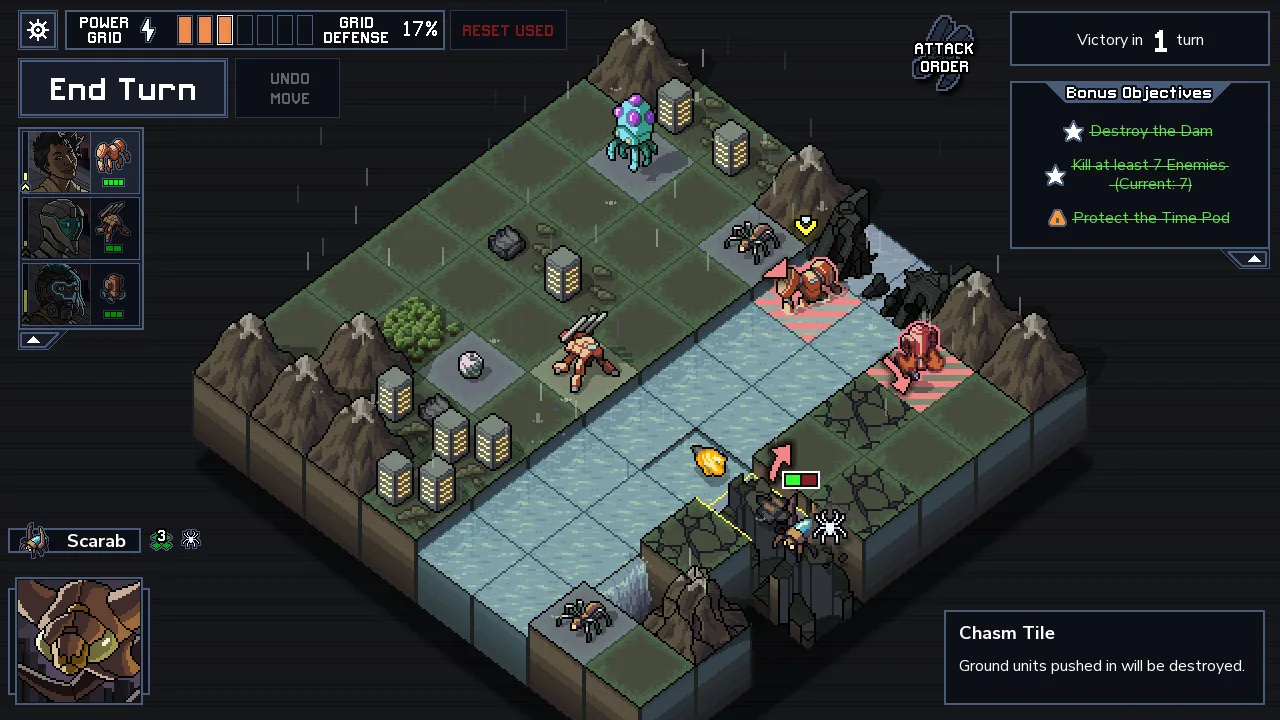
Into the Breach reveals enemy attacks before the player acts, turning defense into a spatial planning problem. Protecting buildings often matters more than destroying every enemy immediately.
Base tactical structure; squad-specific and Advanced Edition details excluded.
The appeal
Solve a dangerous situation through a clever sequence of small, understandable actions.
- inspect
- move
- push
- block
- attack
- protect
- upgrade
Gameplay loops
Moment-to-moment loop
Read telegraphed threats, order mech moves and attacks, resolve the enemy phase, and reassess the board.
Session loop
Survive a compact mission while protecting the power grid and pursuing objectives; choose upgrades and subsequent missions.
Across sessions
Repeated timelines build player understanding and unlock different squads; a new run presents another generated challenge.
Mechanics
- Threats are visible
- Subset describes telegraphed enemy attacks and minimal turn-based combat. Uncertainty remains across future turns and generated situations; this is not perfect knowledge of the whole run. [1]
- Buildings are a shared resource
- Civilian buildings supply power to the mechs, making their defense central rather than merely decorative. [1]
- Iteration around readable tactics
- The developers’ GDC postmortem documents the design process and the decision to show enemy attacks. [2]
A decision
One enemy threatens a building, another threatens your mech, and you cannot kill both.
Damage is one tool among several. Altering geometry can prevent more harm than maximizing immediate damage.
What makes it interesting
Revealing intent shifts the challenge from guessing what might happen to finding an effective response.
A push can solve several threats at once, but it also changes the board for your remaining actions. Finding an order that works is much of the puzzle.
Where it can fall short
- Dense interactions can make a tiny board mentally demanding. Tooltips and previews must explain order and consequences clearly.
- Some situations require accepting losses, so presenting every turn as a puzzle should not imply that a flawless outcome always exists.
Does showing intent make failure more understandable?
Make a five-by-five grid with two defenders, three attackers, one push move, and protected buildings. Play once with declared attacks and once with hidden targets.
Ask players to predict consequences and explain failures; compare planning quality and perceived control, not just win rate.
Notes save in this browser.
Related lessons
- Rules, mechanics, and systems →See how a few interacting rules can produce many situations.
- Choices, uncertainty, and risk →Give players alternatives they can reason about without removing every surprise.
- Feedback and game feel →Make actions legible, responsive, and satisfying to perform.
- Prototyping and playtesting →Turn a design promise into a question you can investigate.
Sources
Mechanics are cited below. The analysis and exercises are our interpretation. About the sources
Checked October 19, 2026.
- Subset Games: Into the Breach ↗Primary description of telegraphs, buildings, equipment, and generated challenges.
- Matthew Davis: Into the Breach Design Postmortem ↗Primary developer presentation on iteration and tactical information.