Portal
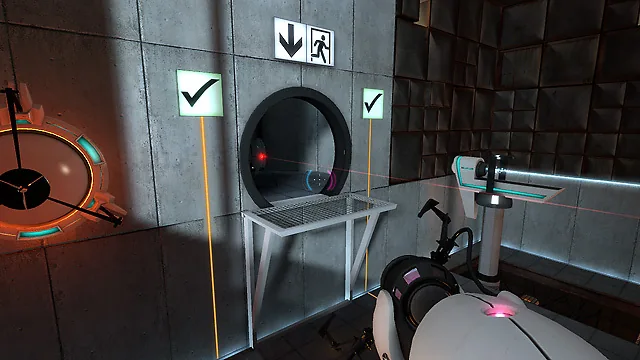
Portal builds puzzles around linked openings in space. Its course of test chambers introduces and recombines that capability, while a speaking antagonist turns an instructional setting into a narrative relationship.
Original 2007 single-player game; not Portal 2.
The appeal
Understand an impossible space, then use that understanding to escape.
- observe
- place portals
- redirect
- carry
- experiment
Gameplay loops
Moment-to-moment loop
Inspect a chamber → form a spatial hypothesis → place portals and manipulate objects → test the result.
Session loop
Solve a sequence of chambers and discover what lies beyond the testing routine.
Across sessions
Learn more demanding applications of the same tool; progression chiefly expands understanding and context.
Mechanics
- A consistent transformation
- Valve describes using portals to manipulate objects and the player through space. Surface restrictions and chamber geometry bound the possibilities. [1]
- Writing and design together
- Swift and Wolpaw’s postmortem treats writing and level design as an integrated process. Narrative delivery works alongside the player’s ongoing problem solving. [2]
A decision
An exit is above you and a deep drop is nearby.
A puzzle becomes teachable when the player can connect a failed test with a specific spatial rule.
What makes it interesting
An unfamiliar mechanic becomes approachable when each room limits irrelevant possibilities. Later recombination can then test understanding rather than memorization.
The institutional voice gives repeated instructions personality, helping ordinary tutorial language carry humor and suspicion.
Where it can fall short
- Tightly authored solutions can produce bottlenecks: one misunderstood concept may stop progress.
- Repeated hints risk taking ownership of the discovery away from the learner; absent hints can create prolonged confusion.
When does a player understand a transformation rather than copy a solution?
Build three small redirect-the-object puzzles: demonstrate a rule, change the layout, then combine it with one previous rule.
Ask players to predict the result before acting. Track whether they can transfer the rule to the unfamiliar room.
Notes save in this browser.
Related lessons
- Rules, mechanics, and systems →See how a few interacting rules can produce many situations.
- Onboarding and accessibility →Help unfamiliar players discover the rules and reach the experience.
- Narrative, theme, and aesthetics →Connect what a player does with the meaning and mood of the experience.
Sources
Mechanics are cited below. The analysis and exercises are our interpretation. About the sources
Checked October 19, 2026.
- Valve: Portal on Steam ↗Developer product description of portals and spatial puzzle solving.
- GDC: A Portal Post-Mortem ↗Primary talk by Kim Swift and Erik Wolpaw about integrating writing and design.