Rock-Paper-Scissors
Rock-Paper-Scissors illustrates cyclic relationships and hidden simultaneous choice. No gesture defeats both alternatives, so the interesting uncertainty comes from the opponent’s concealed choice rather than a complex board.
Three-gesture simultaneous-reveal game; WRPSA rules are one explicit match convention.
The appeal
Commit, reveal together, and wonder whether you read the other person correctly.
- choose
- conceal
- reveal
- compare
- adapt
Gameplay loops
Moment-to-moment loop
Choose a gesture privately, reveal simultaneously, resolve the matchup, and update expectations.
Session loop
Repeat rounds under an agreed format; WRPSA’s standard match is first to two decisive wins, replaying ties.
Across sessions
There is no built-in unlock system. Repeated opponents create opportunities to notice habits, without guaranteeing that any observed pattern will continue.
Mechanics
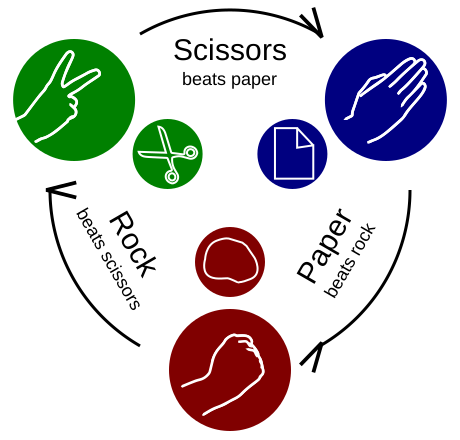
- A cycle, not a ladder
- Rock beats Scissors, Scissors beats Paper, and Paper beats Rock. Identical gestures tie. [1]
- Timing preserves the decision
- The WRPSA convention requires simultaneous reveal on Shoot and penalizes late throws; reacting after seeing the other hand undermines independent choice. [1]
A decision
Your opponent has chosen Rock twice.
Past choices may suggest a pattern, but your opponent can change their next move.
What makes it interesting
Cyclic counters keep a single option from being strictly superior across all opposing choices. This structure can inspire unit or ability relationships in larger games.
Much of the decision depends on secrecy and simultaneous commitment. If one player revealed first, the other would face a very different strategic problem.
Where it can fall short
- Short rounds and little persistent state can limit variety for some players; social context and match framing contribute much of the experience.
- A balanced relationship between options does not guarantee equally skilled players, fair execution, or a satisfying larger game.
What changes when one option becomes generically stronger?
Run twenty simultaneous rounds. Then add a fourth gesture that defeats two existing gestures and loses to only one.
Record selection frequencies and ask whether the new option crowds out others. Switch reveal order once to expose the role of hidden commitment.
Notes save in this browser.
Related lessons
- Rules, mechanics, and systems →See how a few interacting rules can produce many situations.
- Choices, uncertainty, and risk →Give players alternatives they can reason about without removing every surprise.
- Challenge, difficulty, and fairness →Create opportunities to learn and choose how costly failure should be.
- Multiplayer and social design →Design the relationships between people as carefully as the rules of a match.
Sources
Mechanics are cited below. The analysis and exercises are our interpretation. About the sources
Checked October 19, 2026.
- WRPSA: Official rules, version 1.0 ↗Primary rules from one competitive association; cited as an explicit convention rather than universal ownership of the traditional game.