Tetris
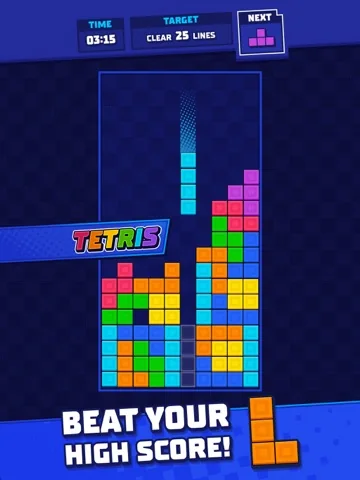
A compact rule set creates a changing spatial puzzle. You balance clearing rows now against the shape you leave for future pieces.
Single-player falling-block play; scoring, speed, rotation, and randomizers vary by edition.
The appeal
Bring order to a growing pile under time pressure.
- move
- rotate
- drop
- plan
Gameplay loops
Moment-to-moment loop
Inspect the falling piece → choose a placement → lock it → clear completed rows → reassess the stack.
Session loop
Keep the board survivable while pursuing a score, line target, or personal best.
Across sessions
Improve recognition, placement speed, and recovery; a traditional marathon needs no permanent character upgrades.
Mechanics
- Persistent consequences
- Completed horizontal rows disappear, while uncompleted blocks remain. The next decision therefore inherits the geometry of earlier decisions. [1]
- Pressure and relief
- Pieces fall into a bounded matrix; many editions increase speed. Clearing rows creates room for a while, but the underlying pressure continues. [2]
A decision
A narrow well could accept a long piece, but the stack is getting high.
The appropriate move depends on survival needs and the edition’s scoring incentives; a higher-value clear is not automatically the safer choice.
What makes it interesting
The stack records your earlier choices. Holes and uneven surfaces remain visible as problems to solve.
Clearing a line can feel satisfying because it visibly resolves a problem you built up. Both planning the placement and executing it contribute to that relief.
Where it can fall short
- Random sequences can create difficult situations; preview, hold, and rotation systems materially change how much control players have.
- Rising speed can turn a planning game into an execution barrier. Different modes should be evaluated separately.
Does preview make decisions feel more deliberate?
Build a paper placement puzzle with a fixed sequence. Compare seeing one upcoming piece with seeing none.
Record covered holes, hesitation, and explanations of choices. Ask whether mistakes felt understandable.
Notes save in this browser.
Related lessons
- Rules, mechanics, and systems →See how a few interacting rules can produce many situations.
- Choices, uncertainty, and risk →Give players alternatives they can reason about without removing every surprise.
- Challenge, difficulty, and fairness →Create opportunities to learn and choose how costly failure should be.
Sources
Mechanics are cited below. The analysis and exercises are our interpretation. About the sources
Checked October 19, 2026.
- The Tetris Company: About Tetris ↗Official overview of movement, rotation, increasing speed, and line clearing.
- Licensed Pocket Tetris instructions ↗Primary manual for one classic-style implementation; do not generalize edition-specific rules.