Tic-Tac-Toe
Tic-Tac-Toe is a compact example of rules that are easy to communicate and inspect. It also shows why learning a game can change its appeal: optimal play by both sides produces a draw.
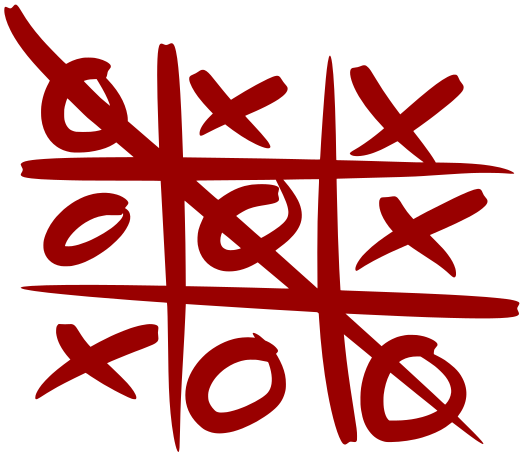
Standard three-by-three, alternating X and O; three in a row wins.
The appeal
Spot a threat, set a trap, and learn to predict another player’s next move.
- place
- block
- threaten
- predict
Gameplay loops
Moment-to-moment loop
Inspect the full board, place one mark, and respond to the opponent’s changed threats.
Session loop
Alternate placements until a line is completed or the board fills; reset for another round.
Across sessions
There is no built-in content or statistical progression. Players develop recognition of threats, forks, and optimal responses.
Mechanics
- A fully visible state
- The Harvard exercise represents a three-by-three board with X, O, and empty cells, legal actions, outcomes, and an optimal-move procedure. [1]
- Solved does not mean universally unenjoyable
- The same exercise states that optimal play on both sides ties. That mathematical outcome is different from a claim about every learner’s experience. [1]
A decision
Your opponent has two marks in a row, while you have an attractive developing line elsewhere.
Visible options are not always meaningful alternatives. Some states have a forced response when the goal is avoiding defeat.
What makes it interesting
The game is valuable for teaching foresight because its consequences are inspectable and rounds are short.
Once both players know the optimal responses, there is less left to discover. Changing the board or objective gives them a new problem to solve, though extra size can also make rounds tedious.
Where it can fall short
- Experienced players may find repeated draws uninteresting; beginners may still find discovery and social play rewarding.
- Adding complexity can deepen choices while damaging the original advantage of instant explanation.
How does mastery change interest?
Play five ordinary rounds, teach immediate wins and blocks, then try a four-by-four board with a clearly stated win length.
Record surprises, forced moves, and desire to replay. Separate skill mismatch from the effect of the rule change.
Notes save in this browser.
Related lessons
- Rules, mechanics, and systems →See how a few interacting rules can produce many situations.
- Challenge, difficulty, and fairness →Create opportunities to learn and choose how costly failure should be.
- Prototyping and playtesting →Turn a design promise into a question you can investigate.
Sources
Mechanics are cited below. The analysis and exercises are our interpretation. About the sources
Checked October 19, 2026.
- Harvard CS50: Tic-Tac-Toe ↗Authoritative teaching reference for board representation, minimax, and the optimal-play draw; the game has no single modern rights holder.