UNO
UNO combines a readable public discard with private hands. Matching restrictions, special cards, and the race to empty a hand create small tactical choices within a social, luck-influenced contest.
Classic matching and action-card rules in Mattel’s English UNO instructions; optional house rules and edition-specific extra wild cards excluded.
The appeal
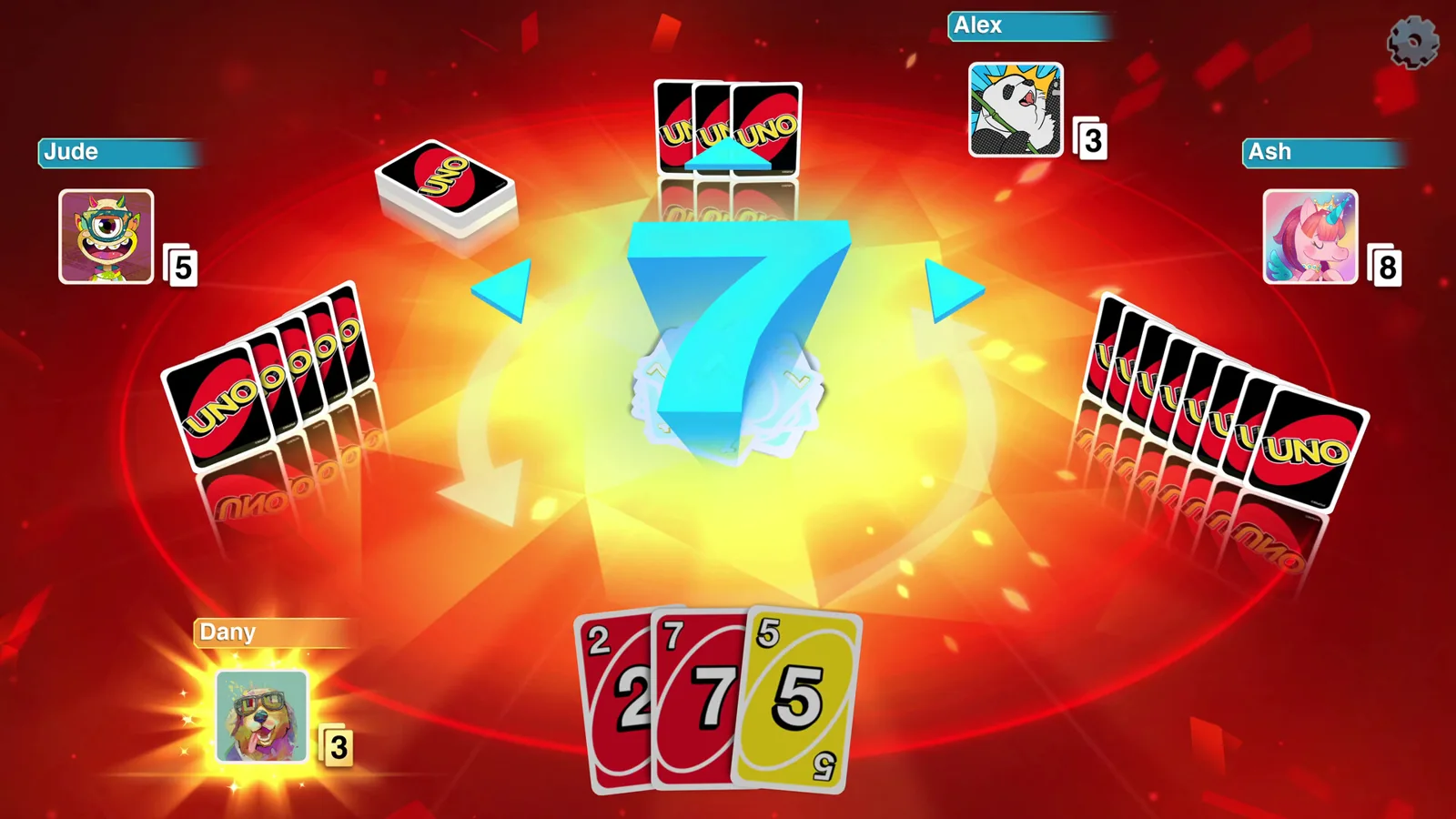
Get close to going out, interrupt a rival, and react together to a sudden reversal.
- match
- play
- draw
- reverse
- skip
- declare
- challenge
Gameplay loops
Moment-to-moment loop
Read the discard, choose a legal card or draw, resolve its effect, and infer what the next player may hold.
Session loop
Reduce your hand to zero while following the UNO declaration and action-card rules; score or start another hand under the agreed format.
Across sessions
The standard game has no unlock progression. Players learn timing, color management, memory, and the group’s agreed rules over repeated hands.
Mechanics
- A simple legality filter
- Mattel’s rules allow matching the discard’s color, number, or symbol, with wild cards providing exceptions. [1]
- Special rules create consequences
- Action cards change turns or force draws. Wild Draw Four has a legality condition and challenge procedure; declaring UNO is required when down to one card. [1]
A decision
You can play a matching number that changes the color or spend a Wild to choose a color favorable to the rest of your hand.
Current hand size, future legal plays, and the next player’s threat can outweigh the immediate benefit of discarding a particular card.
What makes it interesting
A public discard gives everyone a common focus, while hidden hands preserve uncertainty and opportunities for inference.
Nearing zero cards makes the stakes visible. Special-card reversals become social moments because other players can recognize what was almost achieved.
Where it can fall short
- Draw luck can outweigh a good plan in a short hand.
- House rules such as stacking change duration and punishment. Agree on rules before comparing experiences or balancing a prototype.
Does an interruption create playful suspense or excessive delay?
Play a small color-matching prototype with one Skip card, then repeat with several. Keep deck size and player count fixed.
Measure turns spent unable to act, time to finish, and whether interrupted players still feel involved; ask before and after explaining the rules.
Notes save in this browser.
Related lessons
- Choices, uncertainty, and risk →Give players alternatives they can reason about without removing every surprise.
- Challenge, difficulty, and fairness →Create opportunities to learn and choose how costly failure should be.
- Onboarding and accessibility →Help unfamiliar players discover the rules and reach the experience.
- Multiplayer and social design →Design the relationships between people as carefully as the rules of a match.
Sources
Mechanics are cited below. The analysis and exercises are our interpretation. About the sources
Checked October 19, 2026.
- Mattel: UNO English instruction sheet ↗Primary English rules; this case uses classic matching and action rules, excluding edition-specific extra wild cards.
- Mattel: UNO product support ↗Official entry point identifying the product and linked instructions.